
Policies people actually sign, once.
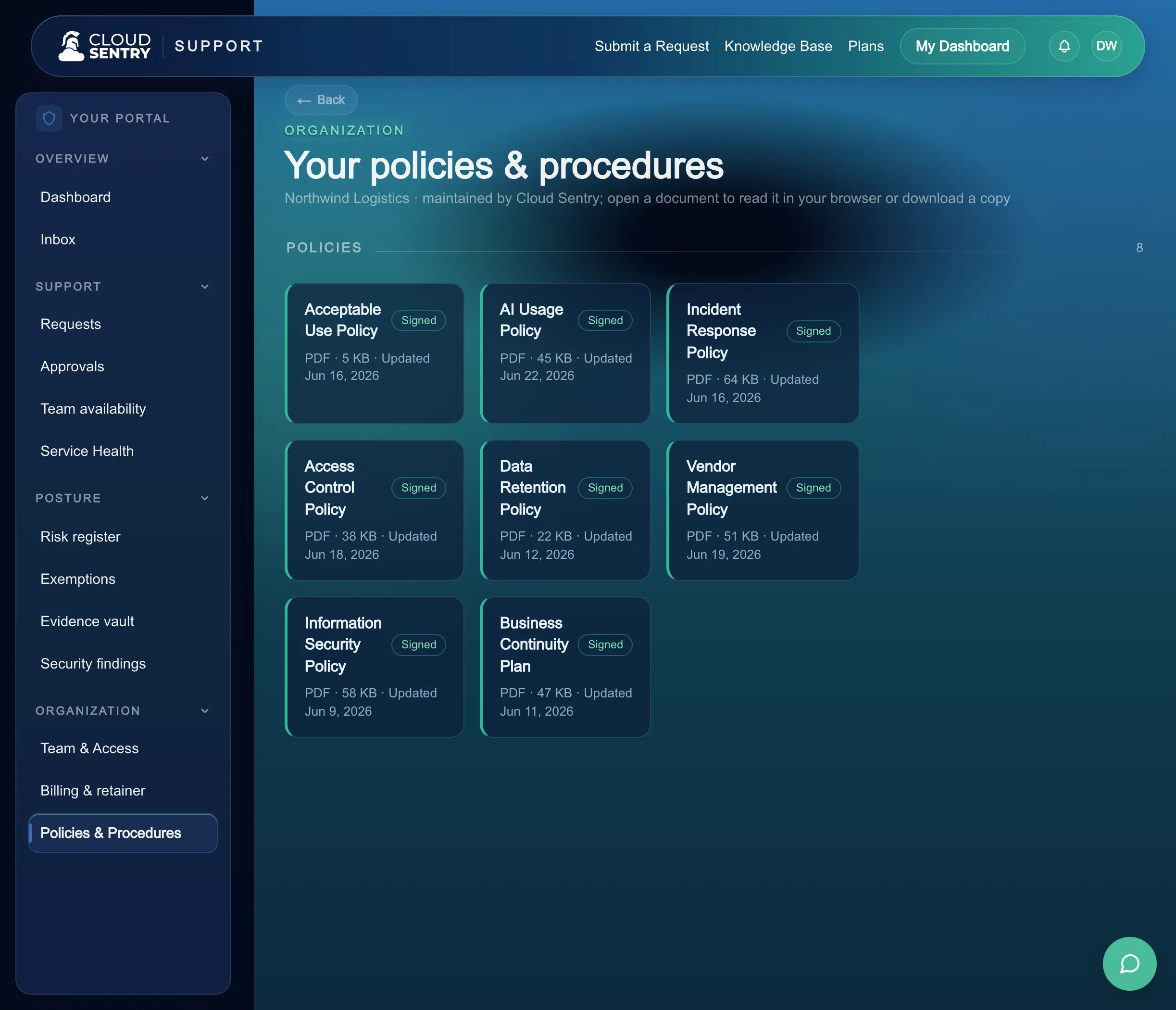
We write and maintain them
Your policies describe the company you are today.
Most policy tools hand you a folder of templates and wish you luck. A year later the dates are wrong, the tool names are wrong, and the document describes a company you no longer are. These are living documents, written and kept current by the same people who run your cloud, IT, and security.
Written for how you actually run
The policy describes the controls that are really in place, because the people writing it are the ones operating them. It reads like your operation because it was written from it.
Kept current as things change
When a tool changes, a process moves, or a control is added, the document that describes it gets updated by the team that made the change, at the time they make it.
Versioned, with a history
Every document carries its version and the trail behind it, so you can see what changed and when. A policy is a record you can trust, with its history in view.
The acknowledgement flow
A clear prompt when something needs signing.
When a document needs a signature, the person sees one prompt telling them what it is and why it matters. They read it, they sign, and it is recorded. No forwarding a PDF, no reply-all, no one keeping a tally by hand.
One clear prompt, right where you are
The person who owes a signature sees exactly what is waiting and what it is for, right where they already work. Nothing is buried in an inbox thread from three weeks ago.
Multi-signatory e-signature
Signing happens in the flow, with a real signature captured against the document version the person actually read. When a policy needs more than one signer, each one signs their part and the document completes once all of them have.
Nobody chasing a spreadsheet
Who has signed and who has not is tracked as it happens, so the tally keeps itself. The person whose job used to be nagging people over email gets that time back.
Illustrative. The person sees the document, the version they are signing, and one place to sign it.
Proof for the audit
Acknowledgement status per person, and the record behind it.
When someone asks whether your team has read and signed a policy, the answer is a status per person. Behind each signature is an audit-log entry: who signed, which version, and when. There is nothing to reconstruct because nothing was tracked by hand.
Illustrative. Status is tracked per person, with the version and the time behind each signature.
A status for every person
For any document you can see who has signed and who is still outstanding, at a glance, so a gap is obvious well before an assessor finds it.
The audit-log entry behind it
Every signature writes a line to the activity log: the person, the document version, and the timestamp. The proof is the record itself, written as it happens.
Nothing to reconstruct
Because the status and the log are kept as people sign, an audit is a matter of showing what is already there, with the paper trail kept as you went.
Where it feeds
Signed policies are part of the proof you hand over.
A signed policy is evidence, and it belongs alongside the rest of what proves your company runs the way it says it does.
The Evidence Vault
Your policies and their acknowledgement status become part of a scoped, time-bounded share. When a buyer or an auditor asks how you handle a control, you hand over the signed policy and the record behind it, on demand.
See how the Evidence Vault worksThe audit trail
Each signature lands in the same activity log the rest of the platform writes to, so a policy acknowledgement sits next to the access grants, the risk decisions, and everything else that makes up your record.
Policies that stay current, signed once, and ready to show.
The team that runs your environment writes them, keeps them current, and captures every signature, so the proof is there when someone asks for it.
Tell us what you run today and we will show you how your policies get written, kept current, and signed on the platform.
Tour the operations platform: the requests, the evidence, the risk register, and the policies your team signs once.