Cloud Sentry
We run it. We don’t recommend it.

IT, security, and compliance, run by people.

Eight functions that usually come from eight different vendors, with nobody accountable for the whole. Here at Cloud Sentry, one team of real people runs all of them.

Already on Microsoft 365? Start today without a call.

What we take off your desk

This work gets an owner long before it breaks.

These are the calls we actually get, and what changes once the work has a name on it.

  1. Access & People Lifecycle
    • A new hire sat idle for three days waiting on access.
    • Someone who left in March still has a mailbox.

    Joiner, mover, and leaver run as one process, with approvals routed to whoever owns the call.

  2. Security Operations & MDR
    • Alerts fire all night and I cannot tell which ones matter.
    • I would hear it from a customer before any dashboard told me.

    Detection and response runs across every layer, handled in view so you watch it happen.

  3. Compliance Program
    • The questionnaire landed and the evidence is in six places.
    • We rebuild the same audit pack every single year.

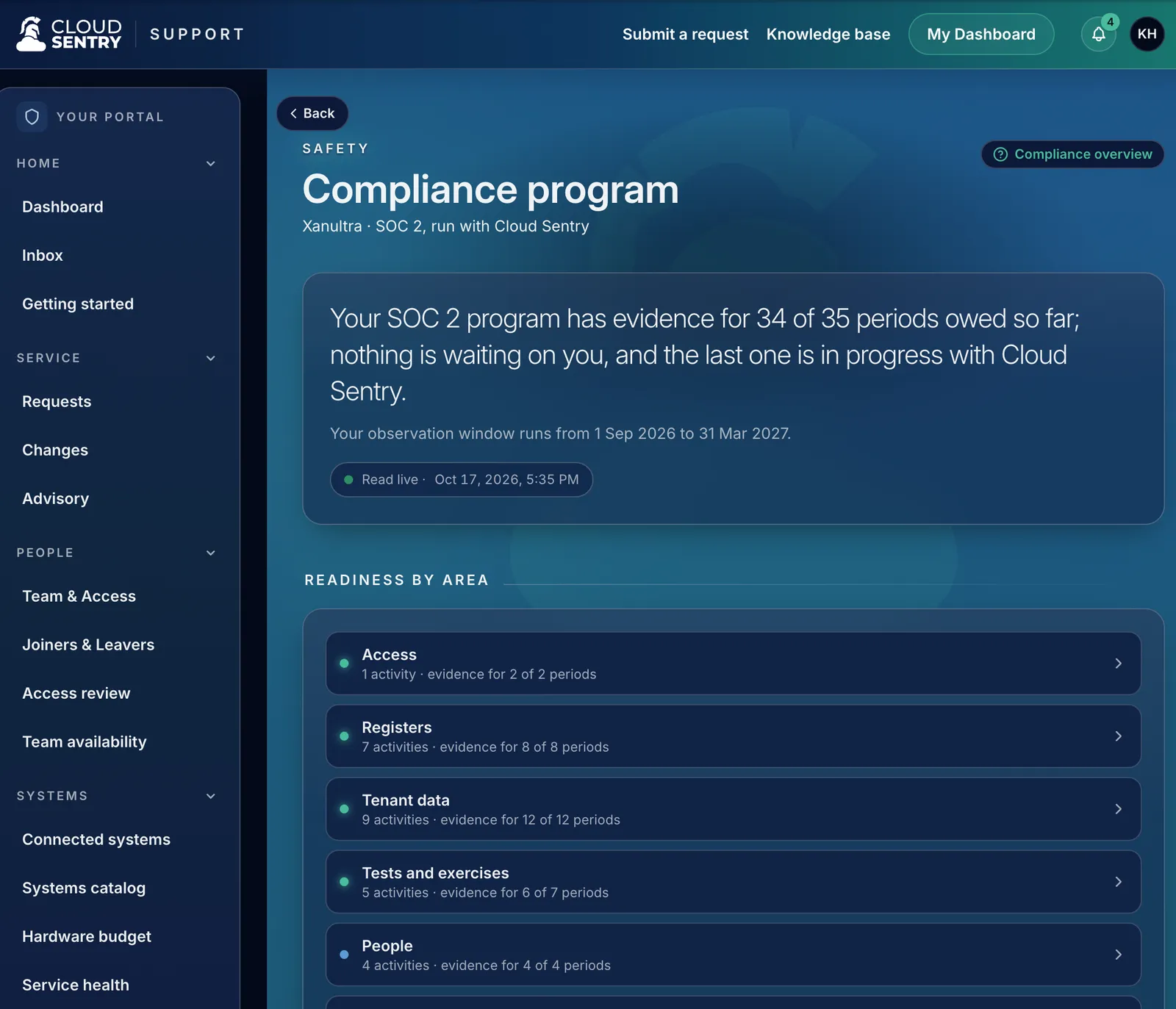
    SOC 2, HIPAA, and HITRUST evidence stays current, so the next review starts from ready.

  4. Risk Management
    • Someone asks what our biggest risk is and I am guessing.
    • The register has not been opened since the last board meeting.

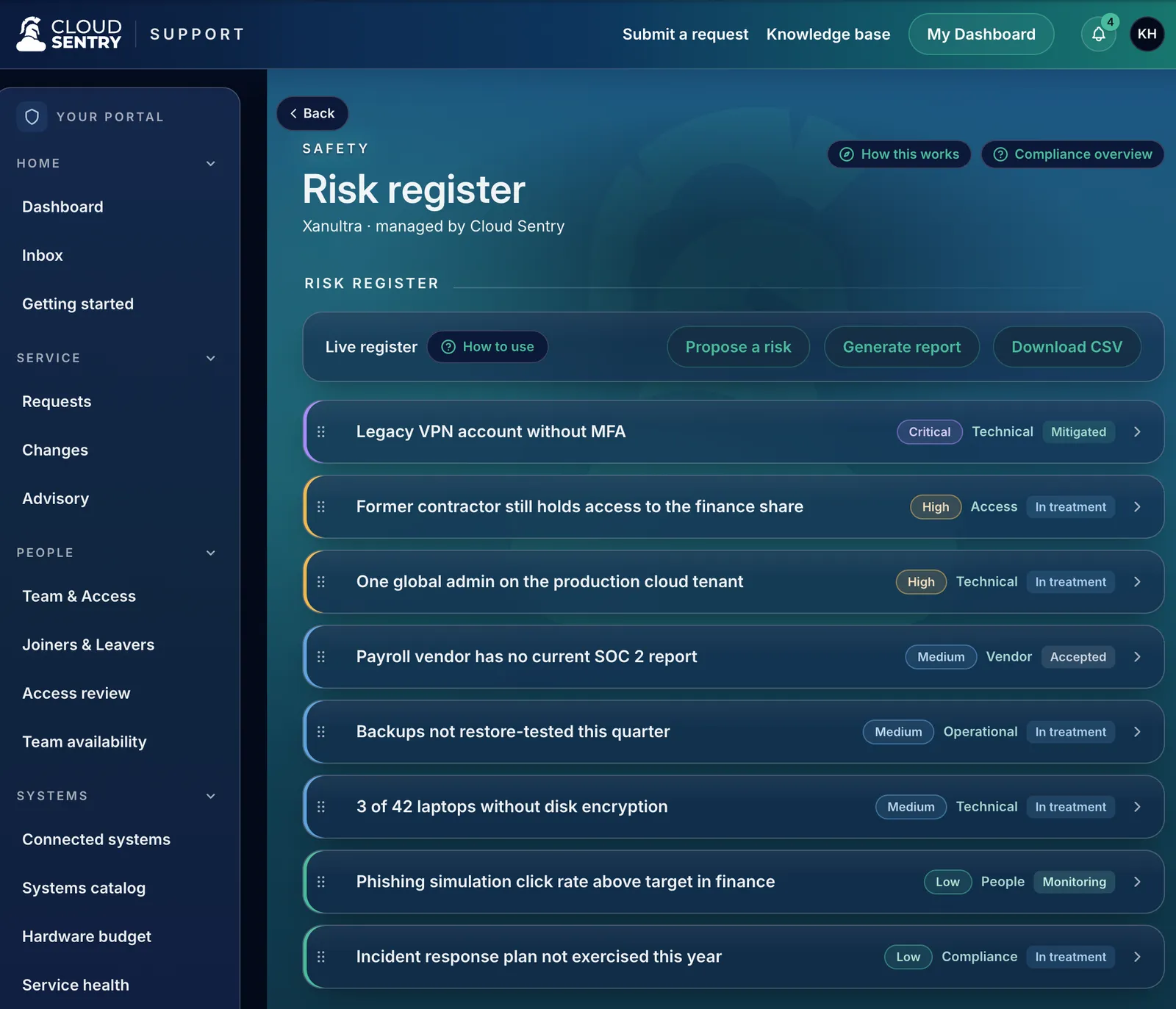
    Every open risk carries an owner and a status, updated as the work moves.

  5. Vendor & Technology Governance
    • Tools get bought and connected faster than anyone can review them.
    • A customer asked who touches their data and I had to go digging.

    Vendors and technology are reviewed and tracked, so governance keeps pace with the stack.

  6. AI Governance & Safe Adoption
    • Half the team started pasting client data into an AI tool and I found out by accident.
    • A customer asked how we govern AI and I had nothing to send them.

    Bring whichever AI tools your team wants. Real governance sits outside the tool, in what it is allowed to reach and what it is allowed to do, so it still holds when everyone moves to something else next quarter.

You already own most of it

A 100-person company spends about this on tools alone.

$48,000

A year, before anyone is paid to operate any of it. Most of what you actually need is already sitting in your Microsoft, Google, and AWS accounts, bought and switched off. We start by turning that on rather than selling you more, and then we operate it.

How an engagement ends

A consultant hands you a list. We hand you a date.

The worst version of this work is an assessment that ends in fifteen things to go fix and an invoice. Ours ends with a finish date, a fixed price, and our team doing the work.

You get a finish date

A consultant tells you what is wrong and stops there. We tell you what is wrong, the date it will be fixed by, and what fixing it costs. In writing, before you decide anything.

We are still here at the audit

A consultant leaves when the report is delivered. We are still here when the auditor arrives, on your side of the table, handing over the evidence.

The price is fixed before we start

Hourly billing rewards a job that grows. Ours is a fixed price agreed up front, and the assessment fee comes off the bill in full if you carry on with us.

From first look to finished

Four steps, and the third one is your finish date.

The four steps below are the whole engagement. You find out where you stand first, and decide after that.

  1. Connect

    Read-only access to what you already run. The security tooling is already sitting in your Microsoft, Google, and AWS accounts, paid for and switched off; the first step is reading it.

  2. Find the gaps

    Every gap, ranked by what will actually block your next deal rather than alphabetically by control number.

  3. Get the date

    Three plans, at three, six, and twelve months, each with a fixed price to get there. Including the honest one, which is what you can do yourself for nothing.

  4. We do the work

    We do the work, in your accounts rather than ours. An independent auditor checks it. The day you leave, everything still works and you still hold every key.

Who actually does it

A person owns your request, with software behind them.

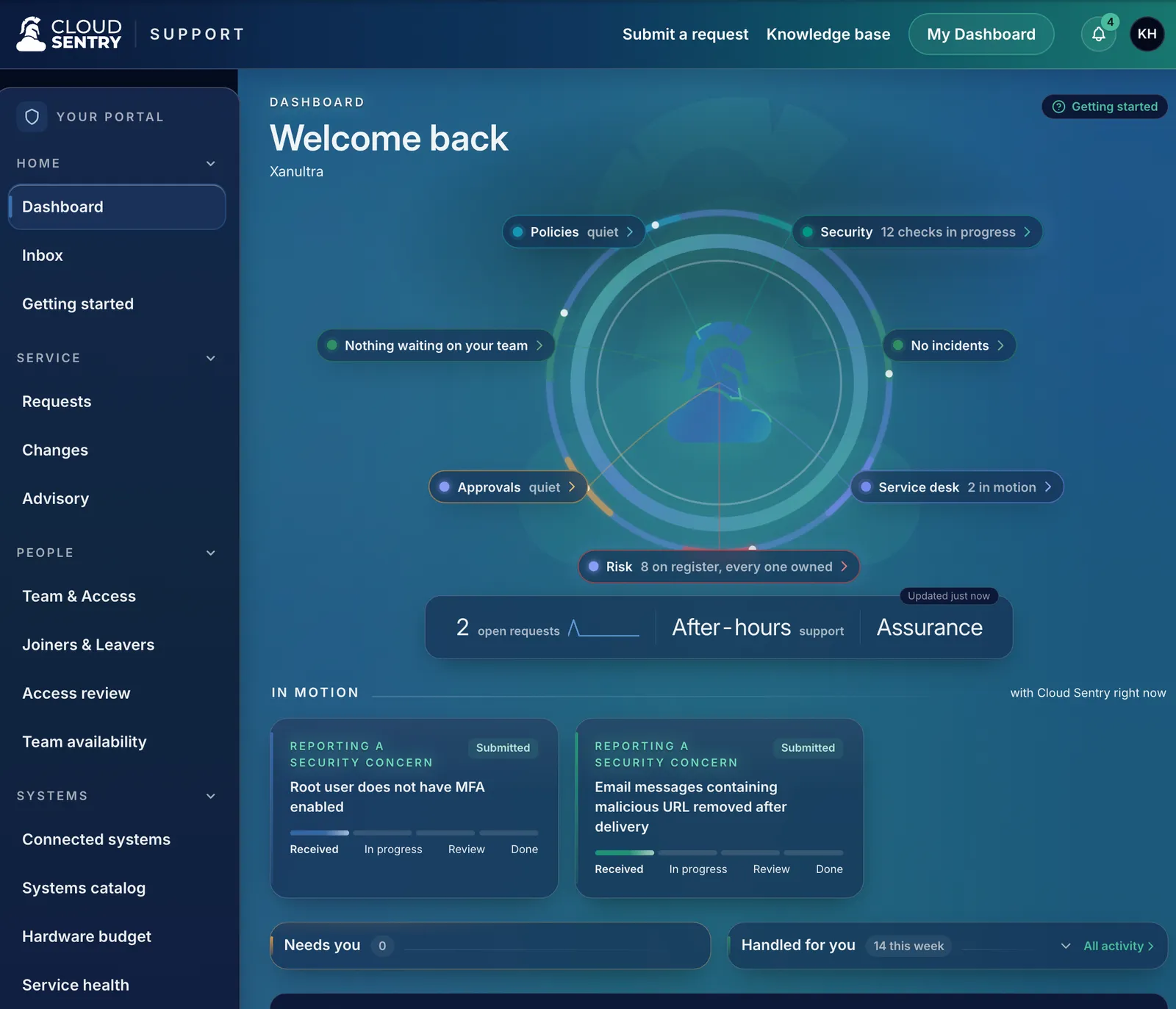
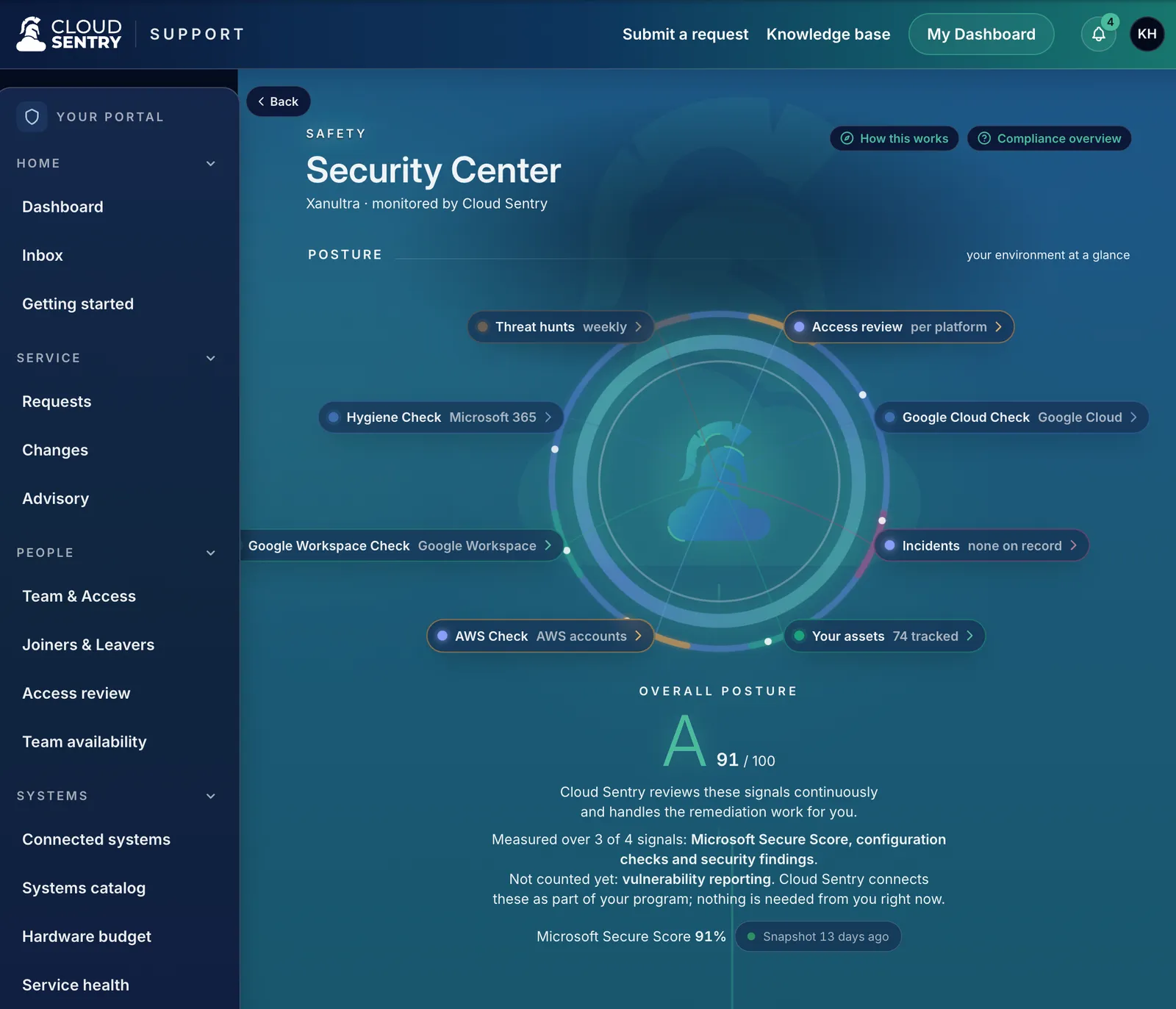
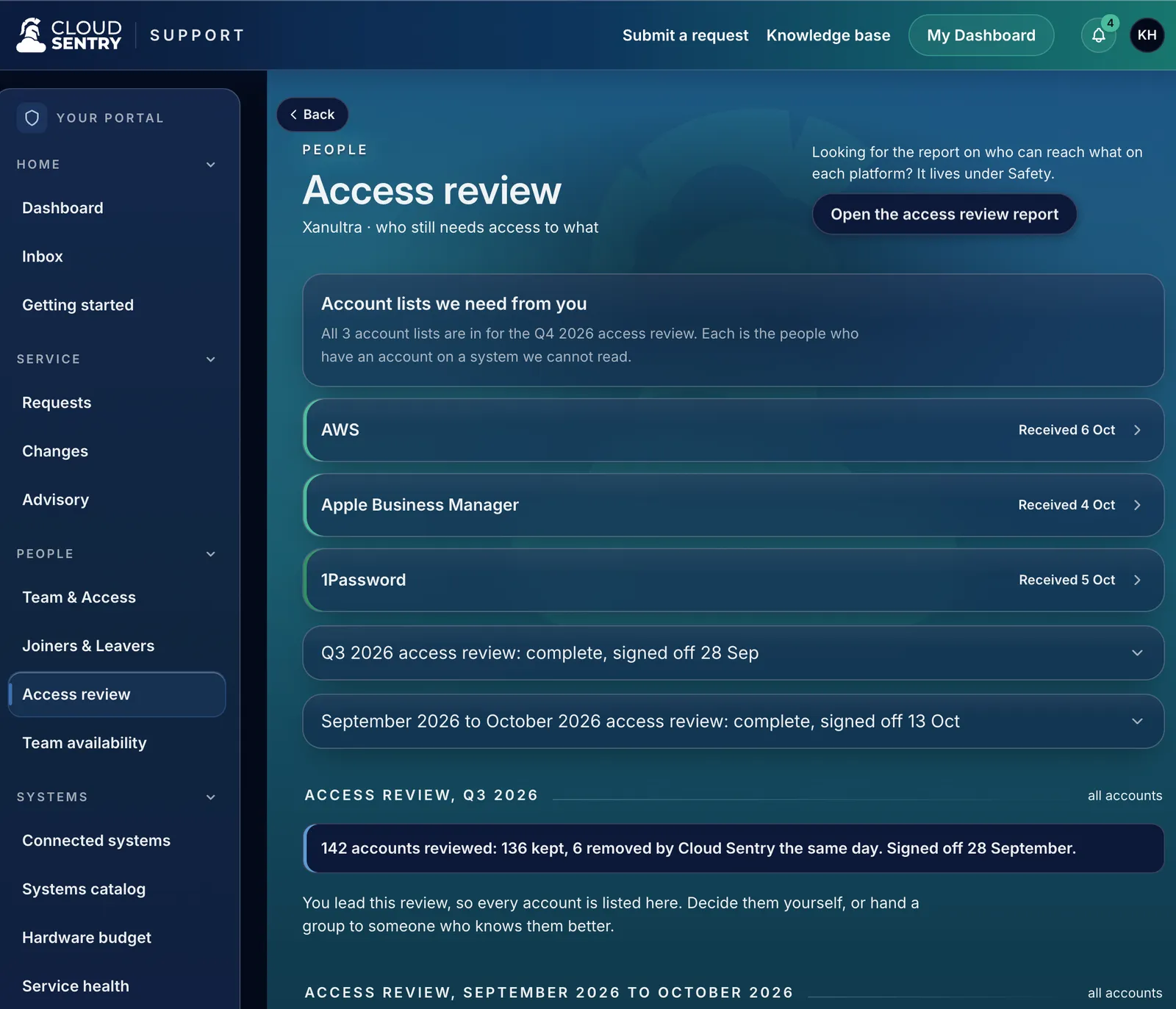
Your queue is worked by an operator who owns each item through to done. The panel here is the same one they work in all day, and you see the rows they see.

A person picks up your request and owns it through to done.

An illustrative sketch. The live console is on the platform page.

The people you would be calling

The people who run your program.

Not a queue, and not an account manager relaying messages. These are the operators who do the work, and you can reach them in the portal.

  • Juston Eubanks, Junior Cloud Operations Specialist

    Juston Eubanks

    Junior Cloud Operations Specialist

  • Jason Bowen, Cloud Operations Specialist

    Jason Bowen

    Cloud Operations Specialist

  • Ken Hanson, Founder & CEO

    Ken Hanson

    Founder & CEO

  • John May, Fractional CIO & Advisor

    John May

    Fractional CIO & Advisor

  • Emil Diaz, Fractional CTO

    Emil Diaz

    Fractional CTO

What you can hold us to

Two commitments that stay fixed.

Accountable people

When something matters, a named person owns it and answers for it. You know who they are, you can reach them, and they do not change every time you open a request.

A predictable bill

A flat retainer, a published structure, and a written cap on the annual escalator. You can read the whole pricing page before anyone calls you.

One engagement, measured

White Star Software

Software / TechOps + SecOps

As White Star Software’s product moved deeper into financial services and healthcare, enterprise buyers began applying production-vendor expectations, and a 200-question audit took eight months to close. Cloud Sentry took over the TechOps and SecOps layer; two enterprise security cycles have since run on a repeatable response framework instead.

8 months → weeks

Enterprise security audit turnaround

Cloud Sentry didn’t feel like a vendor from day one. They felt like a part of our company.

Jonathan Csakany, COO, White Star Software

Five platforms, on purpose

We run five platforms. We turn down work on anything else.

Most providers will run whatever you already have. That is how they end up operating estates nobody can secure or scale, at margins thin enough to force corners on yours. We picked five platforms, we know them completely, and we say no to everything else. It is the reason we can give you a date instead of a discovery phase.

Microsoft 365
Microsoft 365
AWS
AWS
Google Workspace
Google Workspace
Cloudflare
Cloudflare
1Password
1Password
SLA met · 2mevidence filed · 6maccess reviewed · 11mstarter provisioned · 24mpatch window closed · 38mbackup verified · 52mquestionnaire returned · 1hqueue at zero · just nowretainer unchanged · this quarter

Meet the team you would be hiring.

Thirty minutes with the people who would run your queue. Bring your current tool bill if you like; we will walk the comparison together.

Published structure, a written annual escalator cap, and an entry rung you can start today. Read the whole page before anyone calls you.

For the operated partnership: the full function, scoped in a conversation about what you run today and what it costs you.