
Help you can ask for plainly.
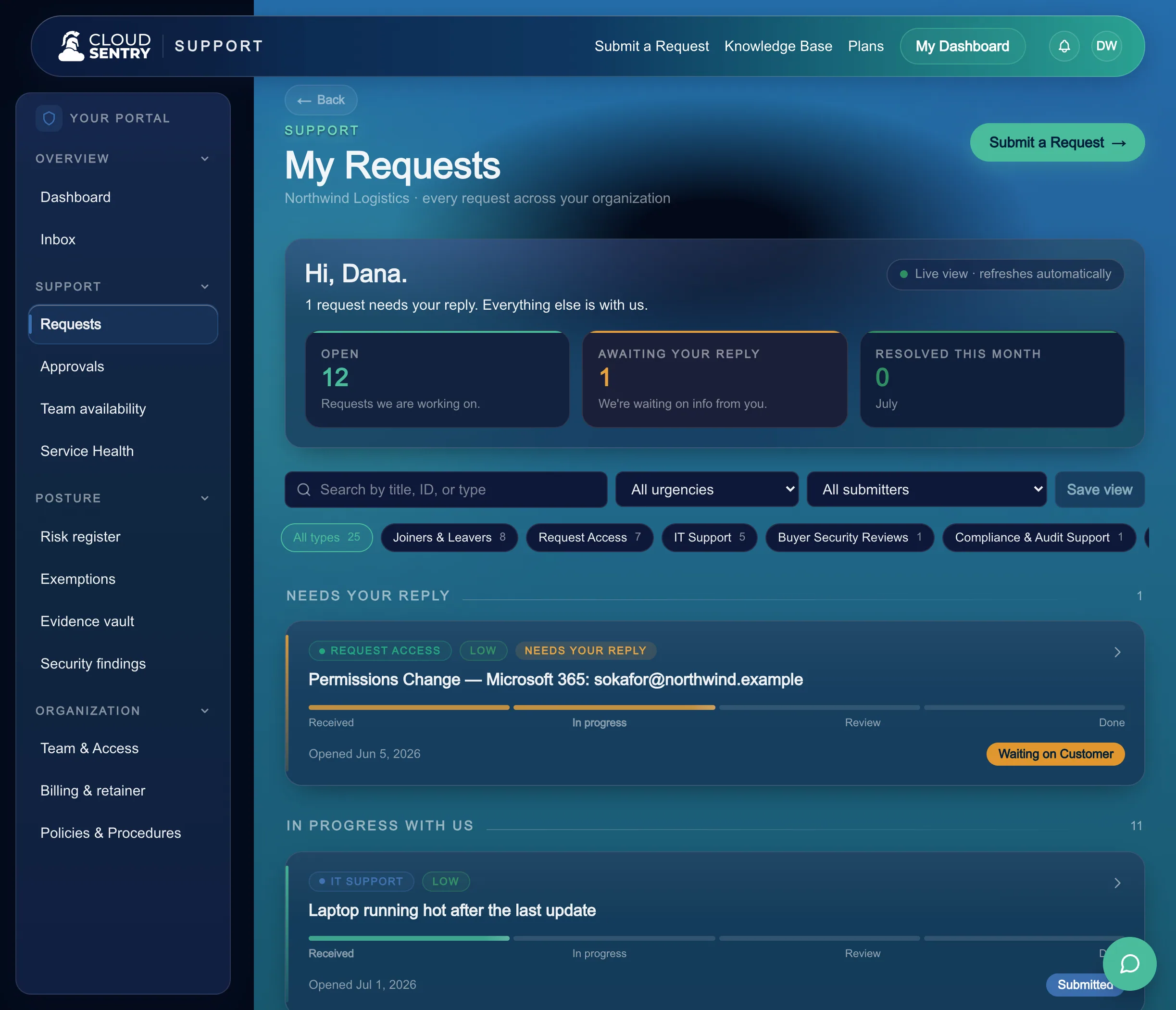
One front door
An IT problem, a security worry, a new hire, the awkward question. All one place.
Companies usually make people learn a map before they can ask for help: this system for tickets, that inbox for security, a form somewhere for onboarding, and a shrug for everything that does not fit. So people stop asking. We collapsed the map into one door. You describe what you need in plain words, and it reaches the right person on our side.
An IT problem
A laptop that will not cooperate, a tool that broke, access that stopped working mid-task. The everyday friction that used to eat an afternoon.
A security worry
A link that looked wrong, a message that felt off, a login you did not recognize. Report it here and it reaches the operators who watch for exactly this.
A new hire
Someone is starting Monday and needs accounts, access, and a working setup on day one. Say so here, and the joiner work runs on the same rails.
A buyer review
A customer or an assessor is asking you to prove you are secure. Start the ask here, and we help you answer it with real evidence you already have on hand.
The awkward question
The thing you feel you should already know, or the mistake you are worried you made. Ask it here. Nobody keeps a scoreboard, and asking early is the whole point.
Everything else
Anything outside the usual categories is still a request. Describe it in your own words and it lands with a person who can route it.
What happens next
The moment you submit, you know where it stands.
The worst part of asking for help is the silence after you hit send. So the request tells you where it stands from the first second: whether someone has it, how serious it is, who is on it, and, the moment the ball is back in your court, that it is your move. No refreshing an inbox hoping for a reply.
A state you can read
Every request wears its current state in plain words: received, in progress, waiting on us, or done. No decoder ring, no color you have to guess at. You always know which of you owes the next move.
A severity, set for you
We set how urgent a request is so the serious ones jump the line, and you can see the level we set. A password reset and a suspected breach do not wait in the same line.
Who is on it
A named person is attached to your request. When you reply, you are talking to someone who already has the context.
An awaiting-your-reply state
When we need something from you to move forward, the request flips to awaiting your reply and says so clearly. The request always shows whose move it is, so the work keeps moving between us.
We commit to a first response, by how serious it is
Every request gets a response-time commitment matched to its severity: the urgent things are answered fast, the routine things soon after. This is a promise about when a person gets to you.
- UrgentSomething is broken or unsafe right now
- HighBlocking your work, but not on fire
- NormalThe everyday ask, answered soon after
A commitment to respond, matched to severity, and held on our side, leaving you clear of the meter you are left to watch.
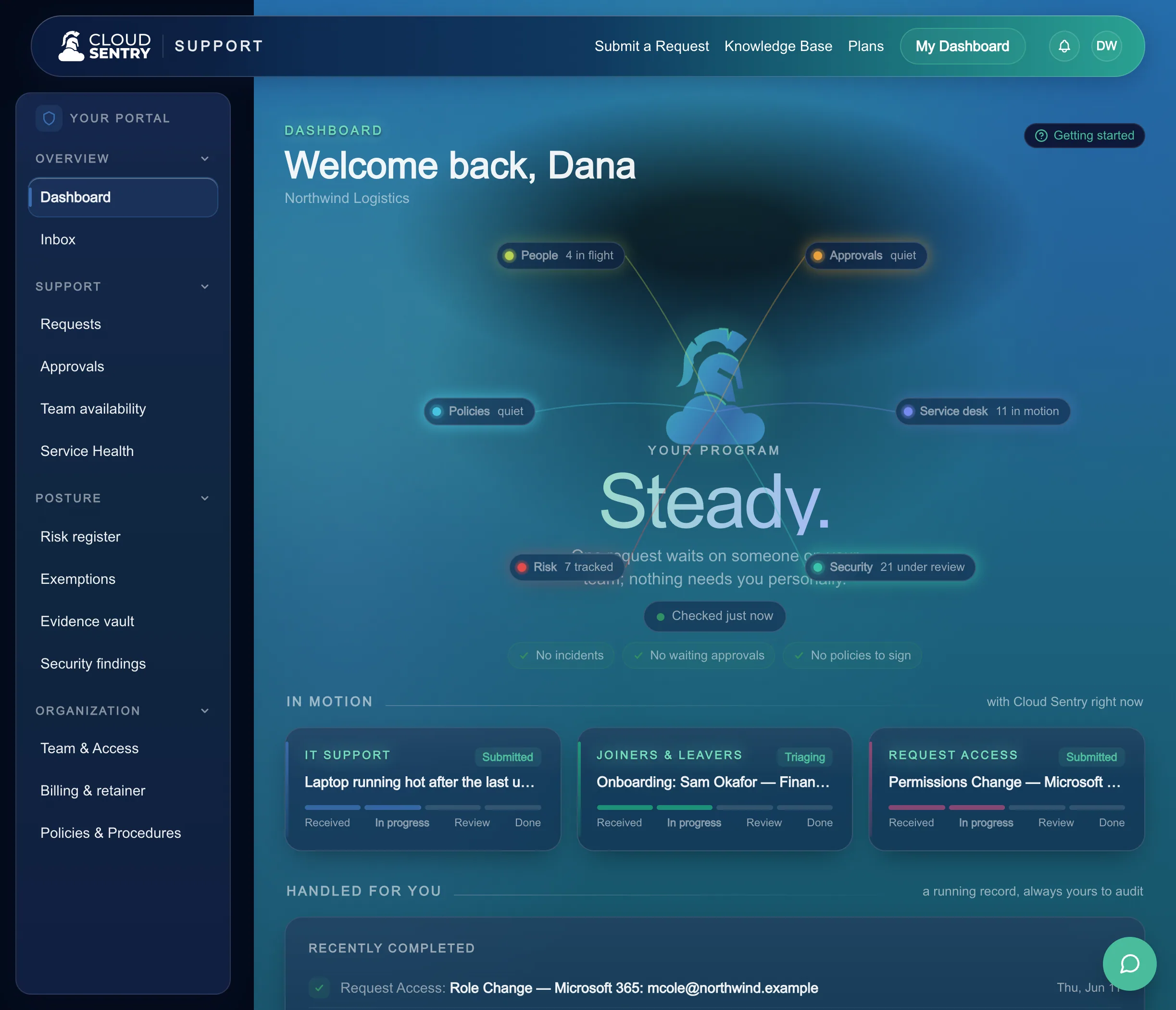
One thread, start to finish
The conversation stays in one place, wherever you answer it from.
Everything about your request lives in one thread: the original ask, every reply, the follow-ups from our side, and the resolution. When we email you, the link drops you straight back into that same thread.
Follow-ups land in the thread
When an operator needs to check something with you, the follow-up appears inline in the same conversation, with its own clear reply state, so nothing splinters into a side channel you have to keep track of.
Email brings you back
The email we send carries a deep link straight to the exact follow-up it is about. One click and you are in the panel, in context, replying in the same thread, right where the conversation left off.
Nothing gets lost between us
Because the whole exchange lives in one thread with a visible state, the request cannot quietly fall into a gap. Either it is waiting on us and we know it, or it is waiting on you and you can see it.
A human, on demand
When it is faster to just talk, there is a person there.
Some things belong in a conversation. Live chat in the portal puts a real person in front of you when you need one, working from the same context as your requests, so you pick up where you left off.
Live chat sits alongside your requests, in the same place you already work. The person you reach can see what you have open, so the conversation starts where you actually are.
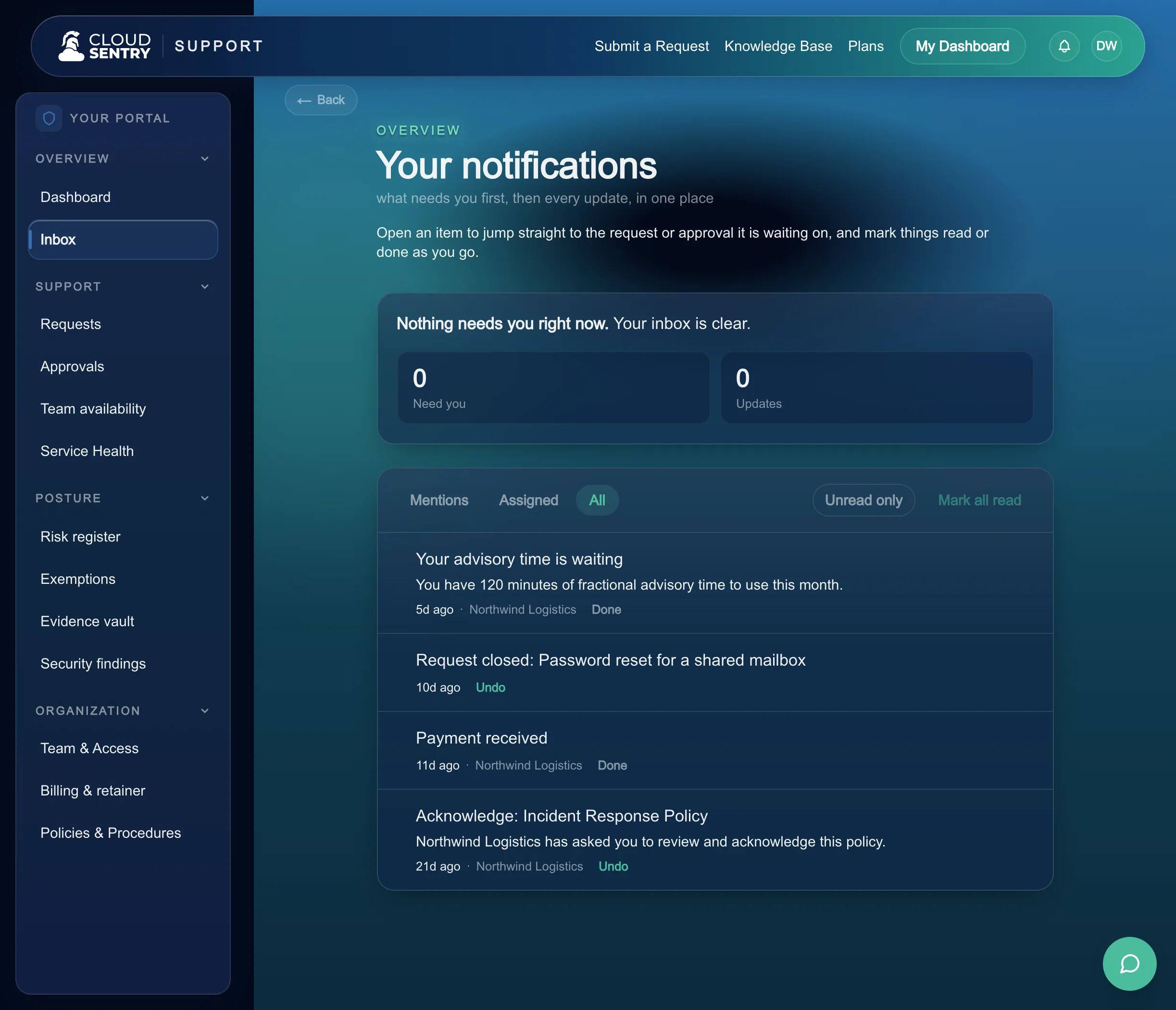
On our side, one inbox, nothing slipping through
Behind the one front door, every request and chat lands in a single operator inbox. That is how a real person answers quickly: the work is in one place, claimed by name, with its state in view.
The operator inbox. Requests are claimed by a named person and worked in the open, which is what lets us answer fast and keep track.
How we grade ourselves
After the work, we ask how it went. Then a lead actually reads it.
When a request is done we ask you a short question about how it went. That answer is how we hold ourselves accountable. Our team leads review it, so a pattern of rushed or unhelpful work has somewhere to surface and someone whose job it is to notice.
Asked after the work is done
The question comes once the request is resolved, so you are rating something that actually happened. It is short on purpose: a moment, and done.
Reviewed by a lead
Your feedback goes to the team leads who own how the desk performs. It is internal accountability, a signal a person is responsible for acting on.
Patterns get caught early
One rough experience is noise; a run of them is a signal. Reviewing feedback in one place is how a slipping response, or an operator carrying too much, gets noticed before it becomes your problem.
A service desk is only good if people are glad to use it.
One front door for anything, a real person on the other end, a clear state the whole way through, and a team that reads how it went afterward. That is the desk, and it is one surface of the platform that runs your cloud, IT, and security.
Find the level of coverage that fits your company, from a single hour of help to your entire stack run for you.
Walk through the desk on a real portal with us, and see what it feels like to ask for help plainly.