
Threats caught, triaged, and handled to closure.
The status quo
An endpoint tool watches one door.
The common setup is a single endpoint tool, deployed once and left to run. It is good at what it was built for, and it is real work. It also covers one door. The identity layer, the cloud layer, and the email and collaboration layer are where a large share of mid-market break-ins actually happen, and an endpoint agent was built to watch the device itself.
A tool that fires an alert still needs someone to act on it. An alert becomes a defense once a person triages, correlates, and answers it. Detection is only worth having when a person owns what happens next.
An endpoint tool, alone
Watches the endpoint, fires an alert, and waits for someone to notice.
Managed detection and response
Watches every layer, correlates the signals, and an operator works the incident to a close.
What we watch
Four layers, one operator watching all of them.
Attacks rarely stay on the endpoint. We watch the four layers where the work actually happens and correlate what shows up across them, so a quiet signal on one layer still gets caught when it looked harmless on its own.
The devices themselves
Laptops and servers watched with Microsoft Defender for Business, which is already included in the Microsoft 365 licenses we manage for you. Suspicious processes, malware, and the behaviour an endpoint agent is built to catch.
Who is signing in
Sign-in and conditional-access signals from your own environment: logins that should not be possible, sessions that do not add up, and access that changed when nobody asked it to.
The environments we run
Cloud-native signals from the accounts we operate for you: keys and roles that drift, storage opened wider than it should be, and configuration that moves away from where it was set.
The inbox and collaboration
Signals from the mail and collaboration platform, where invoice fraud, account takeover, and consent abuse land with nothing running on a device at all.
The path every signal follows, from any layer to an operator who owns the response.
That is the whole idea. A single tool sees one layer and hopes someone is looking. Here, the signals from every layer land with an operator whose job is to act on them.
Who is watching, and when
Coverage, stated plainly.
Resilience tier
Standard business-hours signal triage by our operators.
Detection & Response module
Extended coverage with sev-1 page-out, threat hunting, and incident run.
Enterprise uplift
Staffed around-the-clock coverage, scoped for enterprise engagements only.
No rung oversells the one above it. You know exactly who is watching and when.
How an incident plays out
From a signal to a close, in one place.
When something does happen, it does not disappear into a queue. It moves through a path you can watch, and it ends with a record of what was done.
Detected
A signal surfaces on one of the four layers and is picked up on the coverage window your tier includes, from standard business-hours triage up to staffed around-the-clock coverage on enterprise engagements.
Triaged
It is correlated against what else is happening and given a severity, so real incidents rise and noise settles.
Handled
An operator owns the response and works it to a close, taking the actions the situation needs and telling you what changed.
In view
The whole time, you see it in your portal: what is going on, what we are doing about it, and the one or two things, if any, we need from you.
In your portal
You watch us watch it.
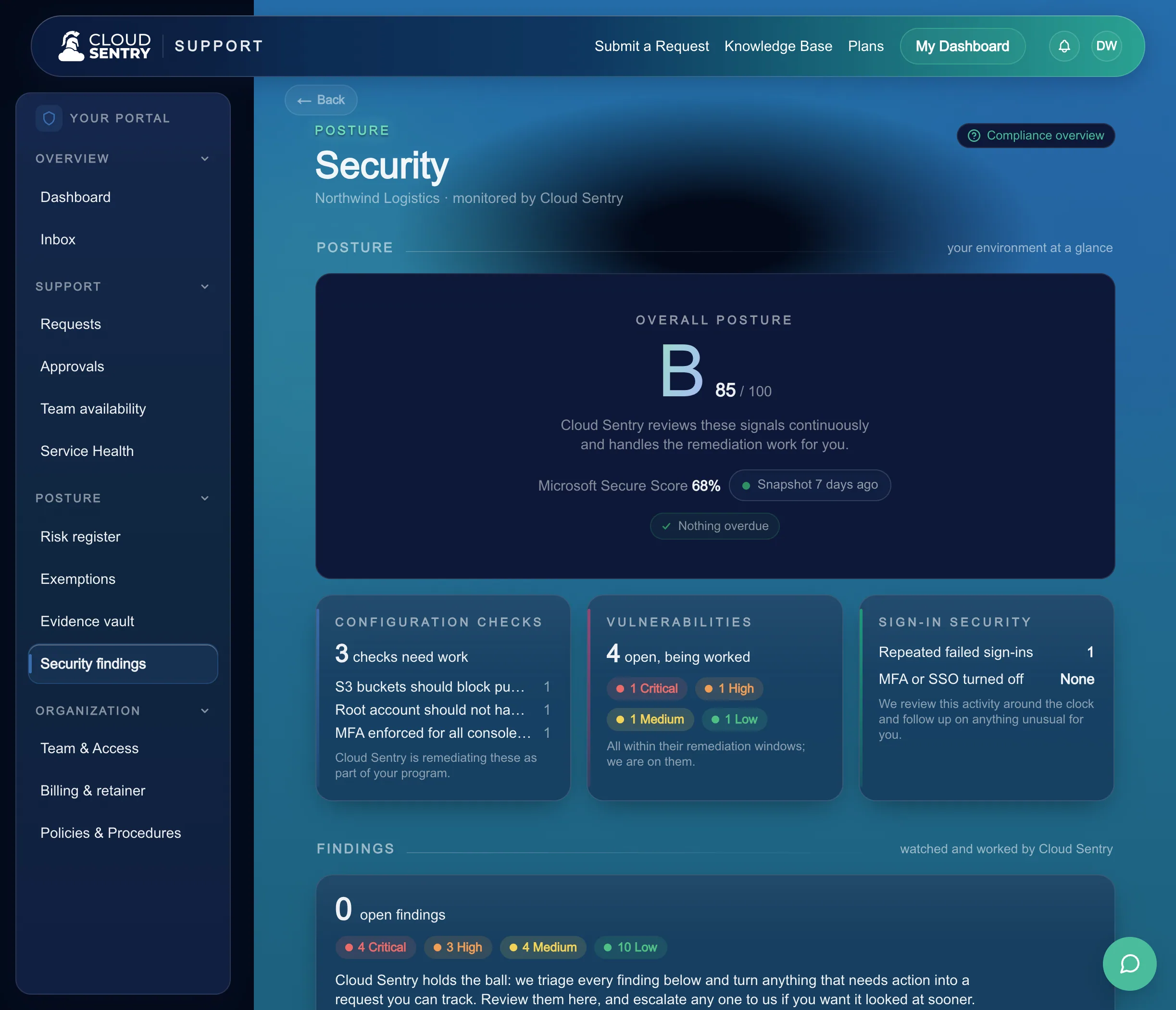
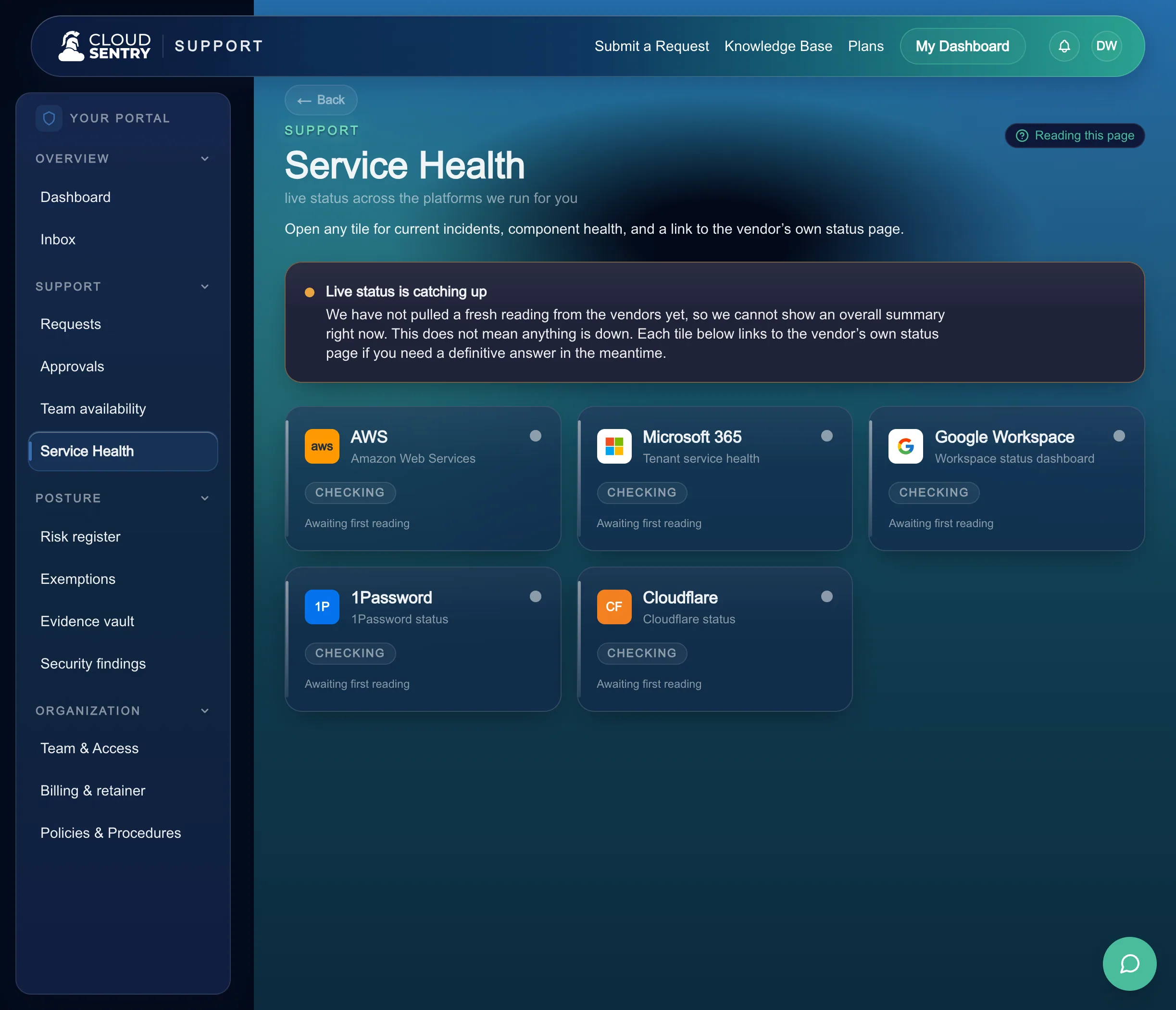
The live status of what we run, and every incident we handle, shows up in one place you control. You do not wait for a monthly report to learn where things stand.
- Live service health. The current state of the environments we run for you, in view, so nothing important is a surprise buried in a PDF.
- Every incident, with its story. What triggered it, what we did, and how it closed, kept as a record you can read later.
- Asked only when it matters. We handle the response. You hear from us when a decision is genuinely yours to make, and not for the noise in between.
Where it feeds
Detection that leaves a record worth keeping.
Handling an incident well is the point. Writing it down is what makes it useful the rest of the year.
The Evidence Vault
The way you detect and respond is part of the proof a buyer or an assessor asks for. What the platform handles is kept current and ready to hand over, scoped and time-bounded, ready on the fire drill.
See how the Evidence Vault worksThe risk register
An incident often surfaces a risk worth tracking. It goes onto the register with an owner and a severity, so what you learned in the moment does not evaporate once the incident closes.
See the risk registerThe team inside
The people who run this with you.
Named operators, reachable in the portal, answering you directly.

Juston Eubanks
Junior Cloud Operations Specialist

Jason Bowen
Cloud Operations Specialist

Ken Hanson
Founder & CEO

John May
Fractional CIO & Advisor

Emil Diaz
Fractional CTO
Detection is only protection when someone answers for it.
We watch every layer, correlate the signals, and work each incident to a close, with the whole thing in view in your portal. Tell us what you run and we will show you how it looks.
Tell us what you run today and we will walk through how detection and response would cover it, layer by layer.
Tour the operations platform: the requests, the evidence, the risk register, and the live status of what the operators run for you.